Prefix (Basic ㊦ 343)
A prefix that expresses politeness.
| おVます | になる | |
| おVます | する | |
| おAdjective い/な | お忙しい | Someone is busy |
| お上手だ | Someone is good at ~ | |
| おNoun | お金 | Money |
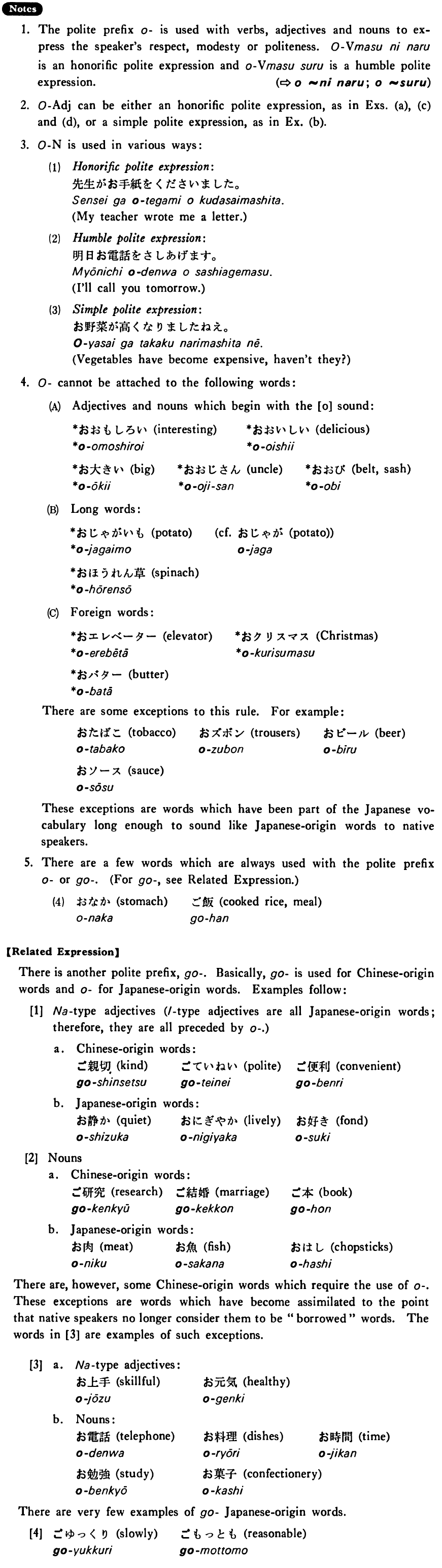
1. The polite prefix お is used with verbs, adjectives and nouns to express the speaker's respect, modesty or politeness. おVerbますになる is an honorific polite expression and おVerbますする is a humble polite expression.
2. おAdjective can be either an honorific polite expression, as in Examples (a), (c) and (d), or a simple polite expression, as in Example (b).
3. おNoun is used in various ways:
4. お cannot be attached to the following words:
There are some exceptions to this rule. For example:
These exceptions are words which have been part of the Japanese vocabulary long enough to sound like Japanese-origin words to native speakers.
5. There are a few words which are always used with the polite prefix お or ご.
【Related Expression】
There is another polite prefix, ご. Basically, ご is used for Chinese-origin words and お for Japanese-origin words. Examples follow:
[1] な type adjectives (い type adjectives are all Japanese-origin words; therefore, they are all preceded by お)
[2] Nouns
There are, however, some Chinese-origin words which require the use of お. These exceptions are words which have become assimilated to the point that native speakers no longer consider them to be "borrowed" words. The words in [3] are examples of such exceptions.
[3]
There are very few examples of ご Japanese-origin words.
[4]